Impact of Oracle Layoffs and How It Affects Software Engineering
Oracle is cutting up to 30,000 jobs to fund its massive AI data center push.
Impact of Oracle Layoffs and How It Affects Software Engineering
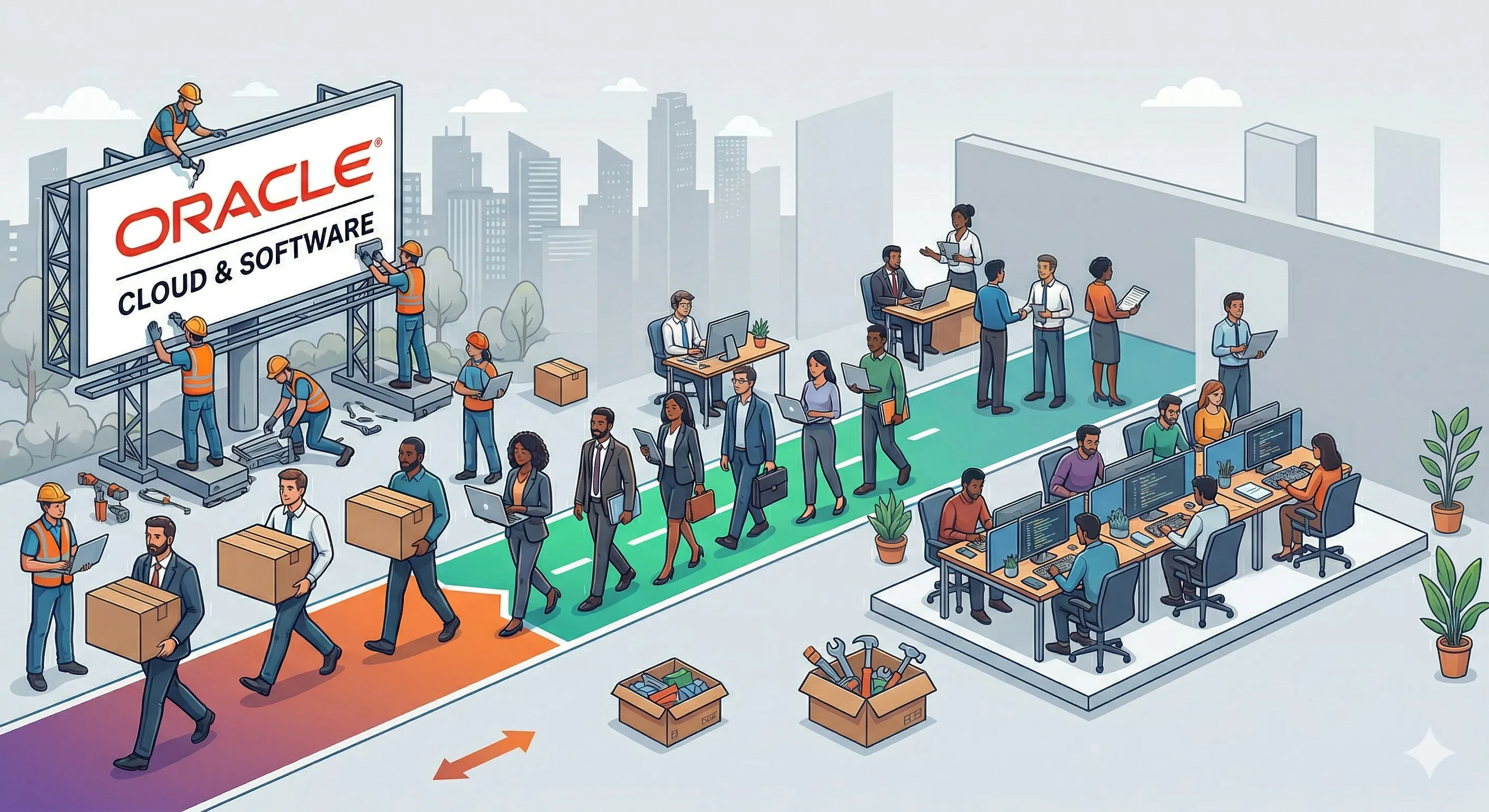
In late March 2026, Oracle stunned the tech world by initiating one of its largest workforce reductions in recent history. Reports suggest the company is cutting thousands of jobs — with analyst estimates from TD Cowen and others pointing to as many as 20,000 to 30,000 positions (roughly 12–18% of its ~162,000 global workforce).
The cuts, which reportedly began on March 31 with early-morning emails notifying employees that "today is your last working day," hit multiple divisions, including Revenue, Health Sciences, SaaS operations, and notably, development centers in India (including NetSuite’s India operations). Many software engineering, project management, and support roles were affected.
While the scale is shocking, Oracle’s stock rose following strong Q3 FY2026 earnings. This isn’t a story of a company in decline — it’s a deliberate strategic pivot.
Why Oracle Is Cutting Jobs: The AI Data Center Cash Crunch
Oracle is in the middle of an aggressive transformation. Once primarily known for enterprise databases and software licensing, the company is now pouring billions into becoming a major player in AI cloud infrastructure. It has committed massive capital expenditures — reportedly up to $50 billion in fiscal 2026 alone — to build out data centers, partly to support high-profile AI initiatives (including partnerships tied to projects like OpenAI’s Stargate).
This expansion has created a severe cash crunch. Borrowing costs are high, banks have reportedly become cautious, and the company has already raised significant debt and equity. To free up $8–10 billion in cash flow, Oracle is reducing headcount and slowing hiring (especially in its cloud division).
Some cuts explicitly target roles that executives believe AI can automate or make less necessary — such as certain coding, testing, support, and routine development tasks. Internal communications reportedly highlighted how AI can now automate large parts of coding and product mocking, allowing the company to "run IT with fewer people."
In short: Oracle is trading human labor for infrastructure and AI capability. It’s a high-stakes bet that the future belongs to companies that own the physical and computational backbone of AI.
How This Directly Affects Software Engineers
The Oracle layoffs are not an isolated event — they reflect broader shifts reshaping software engineering as a profession:
Routine and Mid-Level Roles Are at Risk Roles involving repetitive coding, maintenance of legacy systems, basic testing, or straightforward cloud operations are increasingly seen as automatable. Oracle’s own leadership has signaled that AI tools can handle much of this work faster and cheaper. Software engineers who primarily "glue things together" or maintain existing codebases may find demand shrinking.
Shift Toward AI-Native Skills The winners in this new landscape will be engineers who build, fine-tune, deploy, and scale AI systems. Demand is rising for skills in:
- Machine learning engineering
- MLOps and AI infrastructure
- Prompt engineering + agentic systems
- Distributed systems for massive GPU clusters
- Data pipeline and vector database expertise
Pure application development without an AI angle is becoming table stakes rather than a differentiator.
Job Market Polarization While entry-level and mid-tier software engineering postings face pressure (with some reports of slowed hiring across tech), specialized AI/cloud infrastructure roles remain competitive. Layoffs at giants like Oracle, combined with similar moves at other firms, are flooding the market with experienced talent — intensifying competition for remaining positions.
Geographic Impact India, a major hub for Oracle’s development and support operations, has been significantly affected (reports mention thousands impacted there). This adds to the anxiety in the Indian IT sector, where many engineers already worry about AI-driven productivity gains reducing headcount needs.
Psychological and Career Planning Shift The era of "stable big-tech jobs" feels increasingly fragile. Engineers are realizing that adaptability and continuous upskilling are now non-negotiable. Those who treat learning AI tools (like advanced coding assistants, automation frameworks, and infrastructure-as-code for AI workloads) as a core part of their job will be far more resilient.
Broader Lessons for the Software Engineering Community
Oracle’s move is a loud signal of what many tech leaders are thinking quietly: AI is not just a feature — it’s becoming core infrastructure that changes headcount math. We’ve seen similar patterns at other companies: cost-cutting in traditional roles to fund AI bets, even when overall business performance is strong. This creates a paradox — companies report record earnings and stock gains while reducing staff.
For individual software engineers, here’s practical advice:
- Invest in AI fluency now. Learn to use AI tools to 10x your productivity rather than fear replacement.
- Build domain + tech depth.
- Combine software engineering with deep knowledge in cloud infrastructure, data, security, or industry verticals.
- Diversify your career options. Explore independent consulting, open-source contributions in AI tooling, or roles in AI startups
- Focus on irreplaceable human elements.
The Road Ahead
Oracle’s layoffs highlight a painful but necessary transition. The company is betting big that owning AI data centers will position it as a hyperscaler alongside (or ahead of) AWS, Azure, and Google Cloud. If successful, it could create high-value new roles in AI infrastructure — even as it eliminates others. For software engineering as a field, this is both a warning and an opportunity. The profession isn’t disappearing, but it is evolving rapidly. Engineers who cling to 2010s-era practices risk obsolescence. Those who embrace AI as a powerful collaborator will thrive in the decade ahead.
The future belongs to software engineers who don’t just write code — they architect intelligent systems at scale.
What do you think? Are Oracle’s layoffs a sign of AI-driven efficiency or a cautionary tale for the industry? Have you been upskilling in AI tools? Share your experience in the comments.
If you're a software engineer navigating this shift, feel free to connect — I'd love to hear how you're adapting.