The Picks-and-Shovels Layer of AI Agents Just Minted Another Unicorn
Daytona's $60 million raise reveals why the next AI infrastructure battle may be over where agents do their work
Full Article
Read the complete article, including examples, background, practical insights, and technical details.
The most interesting AI companies might soon be the ones that don't build AI models at all.
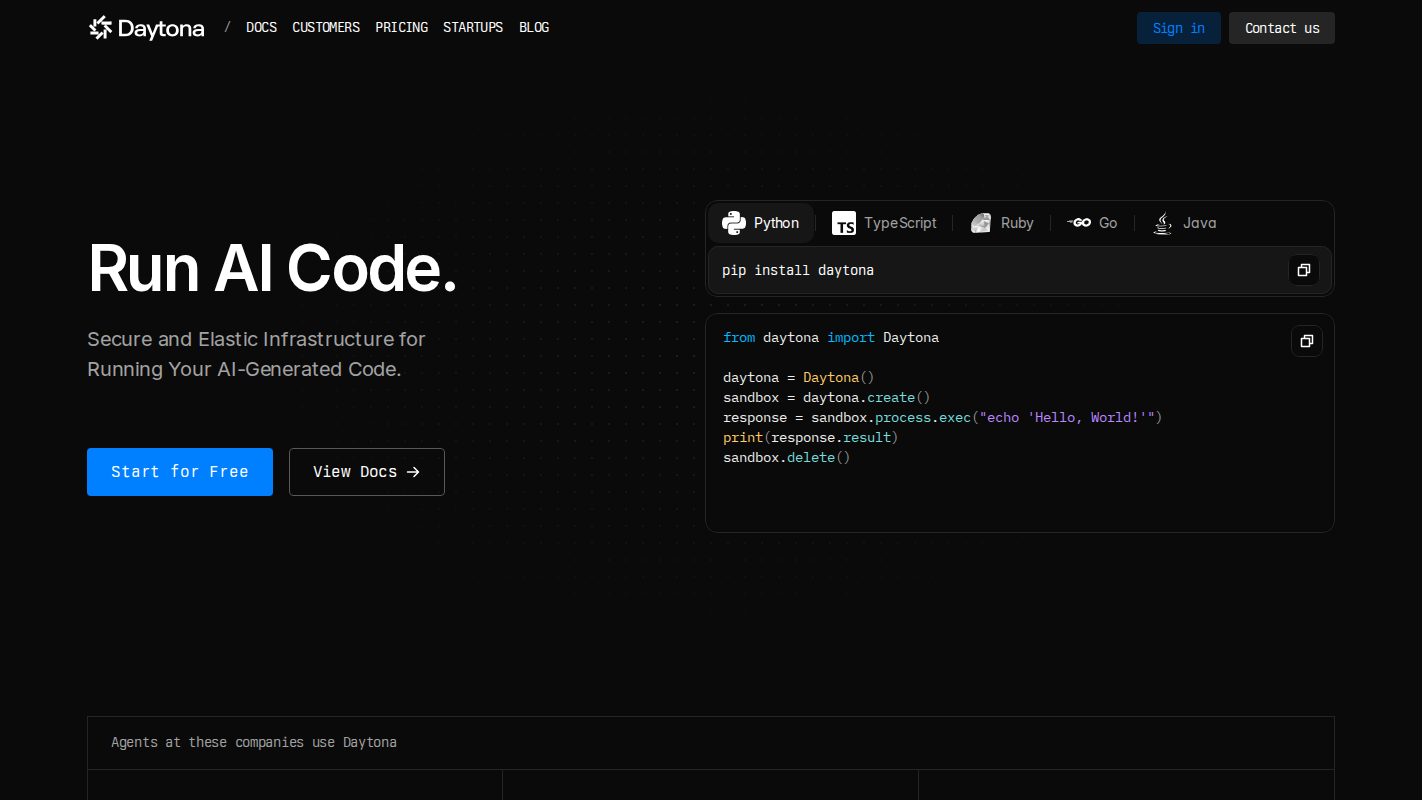
On October 20, 2026, Daytona announced a $60 million Series B at a $1 billion valuation, led by FirstMark Growth. That brings the company's reported total funding to $91 million. Daytona isn't trying to build the next chatbot. It sells isolated computing environments where AI agents can actually perform tasks.
The timing matters. Just a day after Greptile's reported funding round highlighted the growing business of reviewing AI-generated code, Daytona's raise points to another opportunity: providing the computers on which agents run that code.
For years, the AI investment story centered on models and the GPUs needed to train them. Now investors are paying attention to the infrastructure that sits around those models.
1. What Exactly Does Daytona Sell?
Imagine asking an AI coding agent to fix a bug in a React application. The model can suggest changes, but completing the job requires much more. It needs to download a repository, install dependencies, run tests, inspect errors, modify files, and perhaps open a browser to verify the result.
Doing all of that on your personal laptop is inconvenient. Doing it on your production server can be dangerous. Running untrusted generated code in a shared environment creates obvious security risks.
Daytona provides sandboxes: isolated, programmable computing environments that agents can use to execute work. A sandbox can be created for a task, configured with the required tools, and removed when no longer needed.
Daytona's broader pitch is what it calls an Agent Cloud. Instead of treating agent workloads as an awkward variation of ordinary application hosting, it wants to build infrastructure specifically for their behavior.
2. Why Traditional Cloud Infrastructure Isn't Always a Natural Fit
Traditional cloud services are excellent at running websites, databases, APIs, and long-lived business applications. AI agents can behave differently.
A single user request might cause an agent to start several temporary environments, test competing solutions, preserve a promising result, and discard failed attempts. A successful agent may also need to return to unfinished work hours later.
That creates unusual infrastructure requirements:
- Fast startup: New execution environments should be available almost immediately.
- Isolation: One agent's code should not compromise another agent or the host.
- Persistence: Files and execution state may need to survive pauses.
- Forking: An agent may need multiple copies of an environment to test alternative approaches.
- Flexible runtimes: Tasks may need browsers, operating systems, GPUs, and developer tools.
Daytona says its sandbox startup can be around 60 milliseconds in its optimized setup. This is a company-reported performance claim, not a universal benchmark across workloads and configurations.
The key idea is not merely faster virtual machines. It is making computing environments behave like disposable, resumable workspaces for software agents.
3. How an Agent Sandbox Fits into a Real Workflow
Consider an automated pull-request repair system. A developer opens an issue, and an AI agent attempts to resolve it without directly touching production infrastructure.
A possible workflow looks like this:
- An orchestration service receives the issue and assigns it to an agent.
- The agent requests an isolated sandbox from Daytona.
- The sandbox clones the repository and installs dependencies.
- The agent changes code and executes tests inside the sandbox.
- If a fix fails, the system can restore or fork an earlier state.
- A successful branch becomes a pull request for human or automated review.
- The sandbox is paused, retained for debugging, or deleted according to policy.
This is a conceptual architecture, not a claim that Daytona automatically implements every orchestration and review step. The developer still needs to design permissions, validation, logging, and release controls.
The model decides what to try. The sandbox provides somewhere safe to try it.
4. Why Investors Are Paying Attention Now
Daytona's round was led by FirstMark, with participation including strategic investors Qualcomm Ventures, Samsung Next, and Okta Ventures. Its announcement also lists individual investors such as Stripe's Patrick Collison, Shopify's Tobi Lütke, and Perplexity's Aravind Srinivas.
The company's own announcement says revenue has grown approximately 25 times since January and reports roughly 135% average month-over-month net revenue retention. These are Daytona's self-reported metrics. They are not independently audited figures, and they should not be confused with industry-wide growth rates.
Daytona also names customers across model development, training infrastructure, and agent products, including Meta, Cohere, Writer, n8n, Postman, and others. Customer relationships can vary in scope, so a named customer does not necessarily mean every part of its platform runs on Daytona.
The investment thesis is straightforward: if more applications deploy agents that execute real tasks, the number of temporary execution environments could grow much faster than the number of human developers.
That doesn't guarantee Daytona's long-term dominance. It does explain why investors see agent execution as more than a minor developer utility.
5. Greptile and Daytona Reveal a Larger Pattern
The AI coding workflow is gradually separating into specialized layers.
| Layer | Primary responsibility | Example |
|---|---|---|
| Model | Generate plans and code | Coding-oriented language models |
| Orchestration | Coordinate tasks and tools | Agent frameworks |
| Execution | Run code and interact with software | Daytona |
| Verification | Review generated changes | Greptile |
| Delivery | Approve, deploy, and monitor releases | CI/CD and observability tools |
These categories overlap in real products, but the separation is useful. A model can generate a plausible patch without proving it works. A sandbox can execute the patch without proving it is correct. A review system can flag problems without guaranteeing a safe deployment.
Each layer solves a different bottleneck, and each can become a business.
Greptile's reported raise and Daytona's announcement are not proof of a permanent market structure. Together, however, they suggest investors are increasingly interested in the supporting infrastructure of autonomous software development, not just the intelligence powering it.
6. Is This Really a New Cloud Category?
There is a reasonable argument that agent execution is a distinct cloud workload. Agents may create short-lived environments at enormous scale, keep state between actions, and explore many execution paths simultaneously.
Daytona also says its platform supports Linux, Windows, macOS, and GPU sandboxes. That range matters when agents move beyond coding into browser automation, native application testing, design software, and other computer-based tasks.
But calling something a new cloud category does not automatically make it one. Cloud providers already offer virtual machines, containers, serverless computing, managed browsers, and isolation primitives. Agent platforms can assemble these existing capabilities themselves.
The question is whether specialized agent clouds deliver enough improvement in startup speed, state management, operational simplicity, security, and economics to justify an independent platform.
If the answer is yes, this could become an important infrastructure category. If not, sandboxes may remain a feature within larger cloud and developer platforms.
7. The Biggest Threat: Sandboxes Becoming a Commodity
Daytona faces a challenge familiar to almost every infrastructure startup: today's differentiation can become tomorrow's standard feature.
If competitors offer similarly fast sandbox startup, snapshotting, and isolation, customers may start comparing providers mainly on price. Large cloud companies could bundle agent execution with existing storage, networking, identity, and AI services.
Potential sources of durable differentiation include:
- Reliable performance under high concurrency, not just impressive startup benchmarks.
- Security boundaries, policy controls, and enterprise compliance.
- Persistent state, snapshots, and efficient branching across complex workloads.
- Support for multiple operating systems and specialized hardware.
- Developer experience, SDKs, debugging, and operational visibility.
- Predictable pricing for thousands or millions of agent runs.
Daytona's opportunity is to become difficult to replace because it solves the entire execution problem, not because it launches one sandbox a few milliseconds faster.
A fast sandbox is a feature. A dependable execution platform can be a business.
8. What Will Agent Infrastructure Actually Cost?
A quick-start demo can make sandbox infrastructure look inexpensive. Production economics are more complicated.
The real bill depends on how many agents run simultaneously, how long each environment stays active, the CPU and memory allocated, storage persistence, network traffic, and whether GPU acceleration is required.
Consider a hypothetical service launching 100,000 agent jobs per month, each consuming an average of five billable minutes of compute.
That produces:
100,000 jobs × 5 minutes = 500,000 compute-minutes per month
At an illustrative rate of $0.01 per compute-minute, compute alone would cost $5,000 per month. This is not a quoted Daytona price. Real provider pricing, resource tiers, idle charges, storage, and network fees can materially change the result.
An agent that waits for user input or keeps a browser session alive may incur a very different cost from one that finishes a code test in seconds. Pausing idle environments can help, but only if the billing model and application architecture reward it.
Developers should benchmark cost per successfully completed task, rather than focusing only on cost per sandbox or startup latency.
9. What Software Developers Should Learn From This
You do not need to build your own cloud platform to benefit from the shift. But developers building agentic products should understand the execution layer as carefully as they understand model prompts.
For example, a Node.js or Python backend can coordinate an agent while a sandbox handles untrusted code. A React frontend can show task progress, logs, generated artifacts, and review status without granting the agent direct access to production systems.
Important engineering practices include:
- Give each job the minimum credentials and network access it needs.
- Restrict secrets and avoid injecting production credentials into arbitrary code.
- Set CPU, memory, runtime, and spending limits.
- Log commands and preserve artifacts needed for investigation.
- Validate generated outputs before merging or deploying them.
- Treat sandbox isolation as one security layer, not a complete security guarantee.
This creates opportunities beyond coding assistants. Research agents, data-analysis products, browser-based workflows, testing services, and educational coding tools may all need controlled execution environments.
The more autonomy an agent receives, the more important these controls become.
10. What Happens Next?
The next phase of competition will likely be about reliability, economics, and integration rather than a single impressive performance metric.
Specialist platforms such as Daytona can focus on the peculiar needs of agents. Hyperscalers can respond by adapting existing services or building new primitives. Application companies may also bring execution infrastructure in-house once their workloads reach sufficient scale.
It is too early to know which approach will win. Some organizations will value turnkey sandboxes; others will prioritize control, cost, data residency, or integration with their existing cloud.
The most useful question for a buyer is not, "Which vendor has the fastest sandbox?" It is, "Which approach lets our agents finish real work safely and economically?"
That is the question likely to determine whether the Agent Cloud becomes a lasting independent market.
Final Thoughts
Daytona's $60 million raise is notable because it shifts attention from what AI models can say to what AI agents can do.
Models are becoming increasingly capable of writing code and planning tasks. But useful autonomy requires execution environments, security controls, state management, testing, and verification. Those capabilities are not optional extras when agents start performing real work.
The company's $1 billion valuation reflects investor expectations, not proof that a new cloud category has already been won. Its reported growth is promising, but it comes from the company itself, and the competitive landscape is still developing.
What is becoming clearer is that the AI economy has room for companies that never train a frontier model. Some will build the tools that let agents act. Others will build the systems that check whether those actions were correct.
The next wave of AI infrastructure may be defined by the companies that make autonomy practical, trustworthy, and affordable.
TL;DR
- Daytona announced a $60 million Series B at a $1 billion valuation on October 20, 2026, led by FirstMark Growth.
- Its core product provides isolated computing environments where AI agents can execute code and other tasks.
- Daytona reports approximately 60 ms sandbox startup in optimized conditions; actual performance depends on workload and configuration.
- The company reports substantial revenue growth, but those figures are self-reported.
- Together with Greptile's funding news, the raise highlights investor interest in the infrastructure surrounding AI agents.
- The long-term question is whether specialist agent clouds can differentiate beyond sandbox speed before execution environments become commodities.
Sources and Further Reading
- Daytona — Raises $60M Series B to Build the Agent Cloud — company announcement, October 20, 2026.
- Fortune — Daytona, a Startup Building the Agentic Cloud, Valued at $1 Billion — independent reporting, October 20, 2026.
- Daytona — Raises $24M Series A to Give Every Agent a Computer — background on Daytona's sandbox architecture, February 5, 2026.
Editorial note: Funding figures are corroborated by company and news reporting. Startup performance, revenue growth, retention, and customer examples are attributed to Daytona. Cost scenarios and market forecasts are illustrative analysis, not independently verified company results.
Comments load as you scroll…