What Are AWS Trainium Chips? Why Amazon Is Building Its Own AI Hardware
Understanding the processors powering AI training, inference, and Amazon's challenge to GPU dominance
Full Article
Read the complete article, including examples, background, practical insights, and technical details.
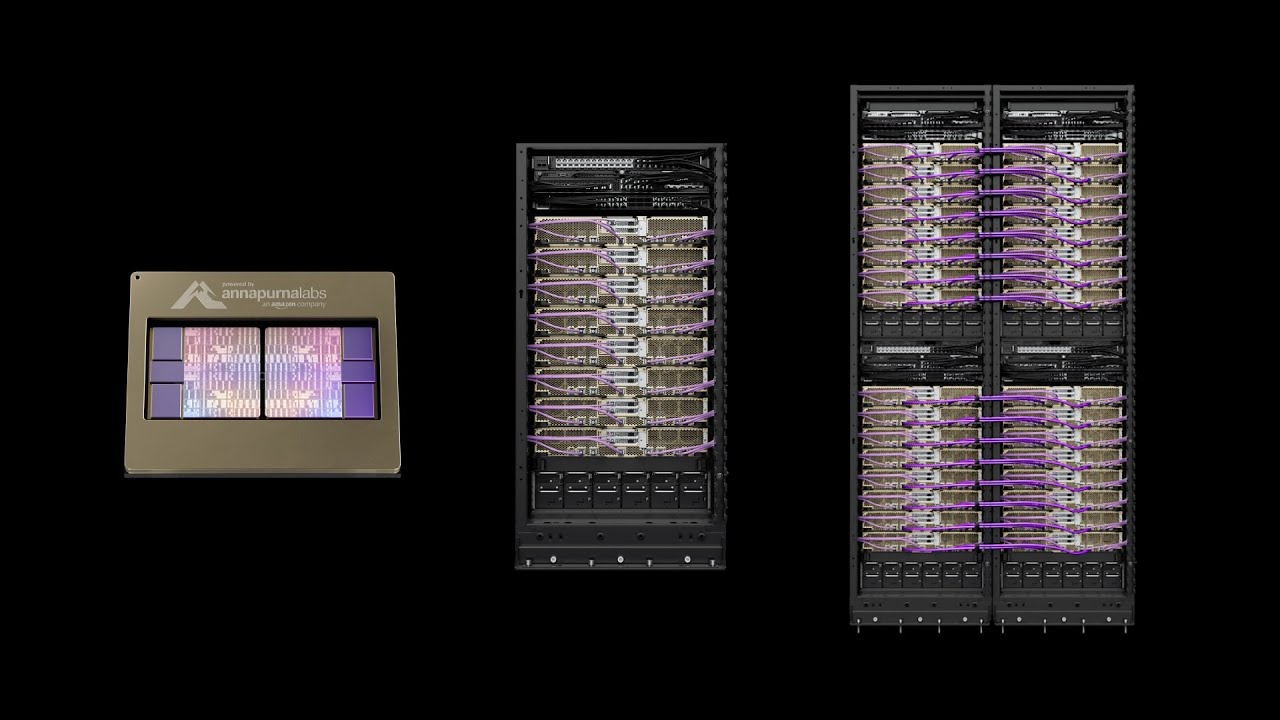
Artificial intelligence may look like software, but behind every chatbot response is a tremendous amount of hardware doing mathematical calculations.
For years, NVIDIA GPUs have been the most recognizable engines of this revolution. But Amazon has been building a different option: AWS Trainium, a family of custom chips designed specifically for large-scale AI workloads.
Why would a cloud provider design its own chips instead of simply buying more GPUs? The answer has as much to do with economics and control as it does with engineering.
1. What Exactly Is Trainium?
Trainium is an AI accelerator designed by Amazon Web Services (AWS). Unlike a general-purpose CPU, it is optimized for the kinds of numerical operations used in neural networks, including large matrix multiplications.
AI models perform billions or trillions of calculations when learning from data. They also perform calculations every time they generate an answer. Specialized accelerators can process these operations in parallel far more efficiently than conventional CPUs.
Although the name emphasizes training, newer Trainium generations support both training (building or updating a model) and inference (running a trained model to produce outputs).
Trainium chips are made available to customers through AWS cloud infrastructure, including Amazon EC2 Trn instances and UltraServers. They are not consumer processors that you install in a desktop computer.
2. Why Did Amazon Build Trainium?
Running AI at scale is expensive. Companies need large clusters of accelerators, high-bandwidth memory, fast networking, power, cooling, and software capable of distributing work across thousands of devices.
If AWS relies entirely on third-party GPUs, it has less control over the hardware roadmap, supply chain, and costs. Designing Trainium gives Amazon another way to optimize its infrastructure around the workloads its customers actually run.
The business goals are straightforward:
- Reduce AI computing costs: improve the amount of useful work delivered per dollar.
- Improve availability: diversify the supply of AI accelerators beyond one vendor.
- Optimize the full system: design chips, networking, servers, and software together.
- Compete for AI workloads: give researchers and companies another reason to use AWS.
These are strategic objectives, not proof that Trainium will be cheaper or faster for every model. Actual results depend on the workload, software support, utilization, and cloud pricing.
3. How Does a Trainium Chip Work?
A useful way to think about Trainium is as a specialized factory for neural-network mathematics.
Inside the chip are NeuronCores, which contain engines optimized for different computational patterns. Tensor engines handle operations such as matrix multiplication, while vector and scalar engines support other parts of the model's computation.
Trainium also uses high-bandwidth memory (HBM). This matters because powerful compute engines are wasted if model weights and intermediate data cannot reach them quickly enough.
For very large models, one chip is insufficient. AWS connects multiple Trainium chips using NeuronLink, then connects larger servers and clusters with high-performance networking. The goal is to let many chips cooperate on a single training or inference workload.
In simplified form, the system looks like this:
- A developer defines or loads a model using a supported framework.
- AWS Neuron software compiles and optimizes the model for Trainium.
- Trainium's compute engines execute the neural-network operations.
- High-bandwidth memory and interconnects move data between components.
- Multiple chips work together when the model or workload is too large for one accelerator.
4. Trainium, Trainium2, and Trainium3: What's Different?
Amazon has evolved Trainium across several generations.
| Generation | Key idea | Example AWS infrastructure |
|---|---|---|
| Trainium (first generation) | Dedicated acceleration for deep-learning training | EC2 Trn1 |
| Trainium2 | Greater compute, memory capacity, and bandwidth for large models | EC2 Trn2 and Trn2 UltraServers |
| Trainium3 | Newer 3 nm design targeting training and inference economics at scale | EC2 Trn3 UltraServers |
According to AWS, a Trainium2 chip provides 96 GiB of HBM and up to 1.3 PFLOPs of dense FP8 compute. Trainium3 provides 144 GB of HBM3e, 4.9 TB/s of memory bandwidth, and 2.52 PFLOPs of FP8 compute.
Trainium3-powered Trn3 UltraServers became generally available in December 2025. AWS says configurations can scale to 144 Trainium3 chips per UltraServer.
These are manufacturer-reported specifications. Peak theoretical performance does not automatically translate into the same improvement for every real-world AI application.
5. Trainium vs NVIDIA GPUs: Is Amazon Replacing NVIDIA?
Not exactly. Both are AI accelerators, but their strengths and ecosystems differ.
| Factor | AWS Trainium | NVIDIA GPU ecosystem |
|---|---|---|
| Main positioning | Purpose-built AWS AI acceleration | Broad acceleration across AI and other compute workloads |
| Access | Primarily through AWS cloud services | Multiple clouds, data centers, and workstation products |
| Software | AWS Neuron SDK and supported frameworks | CUDA and a large collection of established AI libraries |
| Flexibility | Strongest for supported, optimized workloads | Broad tooling and application compatibility |
| Main trade-off | Potential cost advantages versus portability and compatibility work | Mature ecosystem versus pricing and availability constraints |
NVIDIA's advantage is not just silicon. Its software ecosystem, especially CUDA, has years of tooling, libraries, and developer experience behind it.
Trainium's opportunity is to offer competitive economics for specific AI workloads running on AWS. A company deciding between them should benchmark end-to-end throughput, latency, engineering effort, and total cost, rather than comparing chip specifications alone.
6. What Is AWS Neuron, and Why Does It Matter?
A chip is only useful if developers can run their models on it. AWS Neuron is the software development kit and runtime ecosystem that connects popular machine-learning workflows to Trainium hardware.
It provides compilation, runtime support, profiling, monitoring, and integrations with frameworks such as PyTorch. AWS has also expanded support for tools used in modern model training and serving.
However, compatibility is not a simple yes-or-no question. A standard model may work with minimal changes, while a model using unusual operations, custom kernels, or unsupported features may require additional engineering.
For a team adopting Trainium, the first practical step is to verify that its specific model architecture, framework version, and inference or training stack are supported.
7. Where Are Trainium Chips Actually Used?
Trainium is intended for demanding workloads such as:
- Large language model training: learning patterns from enormous text and multimodal datasets.
- Fine-tuning: adapting an existing foundation model to a specialized domain.
- Inference: serving model responses to applications and users.
- Reasoning and agent workloads: processing complex, multi-step AI requests.
- Multimodal AI: supporting models that work with images, audio, video, and text.
AWS identifies Anthropic as a major Trainium customer. Anthropic has described using large-scale Trainium2 infrastructure for training and serving Claude models through its AWS partnership.
This illustrates an important point: Trainium is not merely an experimental alternative. It is being deployed for production-scale AI, although individual organizations still need to validate suitability for their own systems.
8. Why Trainium Matters to the AI Industry
The AI industry is increasingly concerned with the cost of producing and serving intelligence. A model that generates impressive answers but is too expensive to run at scale may struggle commercially.
That shifts attention from model quality alone toward cost per token, latency, power efficiency, memory capacity, and hardware utilization.
Amazon's strategy is to optimize those factors across the entire infrastructure stack. Trainium fits alongside its servers, networking, orchestration services, and cloud platform.
It also introduces more competition into the AI accelerator market. More viable hardware choices could give model builders additional negotiating power and reduce dependence on a single technology ecosystem.
Still, competition does not guarantee lower prices for everyone. Cloud pricing, software migration costs, availability, and contractual commitments all influence what customers ultimately pay.
9. Should Developers Learn Trainium?
If you are primarily building React applications or calling an LLM through an API, you probably do not need to understand Trainium's hardware internals. Your cloud or model provider handles that infrastructure.
But if you work with ML engineering, LLM deployment, model fine-tuning, MLOps, or cloud architecture, understanding Trainium could be valuable.
A sensible learning path is to:
- Understand the difference between training and inference.
- Learn why tensor operations, HBM, and interconnect bandwidth matter.
- Explore the AWS Neuron documentation and supported models.
- Try an official Trainium tutorial in an appropriate AWS environment.
- Benchmark performance and cost against your existing GPU deployment.
Remember that EC2 accelerator instances can be expensive. Review current regional pricing and shut down test resources when you are finished.
10. What Happens Next?
The next phase of AI infrastructure competition is unlikely to be decided by a single benchmark. Companies will evaluate complete systems: silicon, software, networking, power consumption, developer productivity, and operational cost.
NVIDIA remains a major force, while AWS is building a more vertically integrated alternative with Trainium. Other cloud providers and chip designers are also investing in specialized AI accelerators.
The broader lesson is that AI infrastructure is becoming a strategic business differentiator, not merely a technical purchase.
Final Thoughts
Trainium chips are Amazon's attempt to make AI computing more efficient and economical through purpose-built hardware and tightly integrated cloud infrastructure.
They do not make GPUs obsolete, and they are not necessarily the right choice for every AI project. But they demonstrate how important the underlying hardware has become as companies move from experimenting with AI to serving millions of users.
The future of AI will be shaped not only by who builds the smartest model, but also by who can run useful models reliably at a sustainable cost.
TL;DR
- AWS Trainium is Amazon's family of custom AI accelerators.
- It supports model training and, in newer generations, large-scale inference.
- Trainium2 increased compute and memory capabilities over the first generation.
- Trainium3 uses a 3 nm design and targets better performance and efficiency for modern AI workloads.
- AWS Neuron provides the software needed to use Trainium with supported machine-learning frameworks.
- Trainium competes with GPU-based infrastructure, but software compatibility and actual workload economics determine which is better.
- Its importance extends beyond chip performance: Amazon is competing to control more of the AI infrastructure stack.
References
Comments load as you scroll…