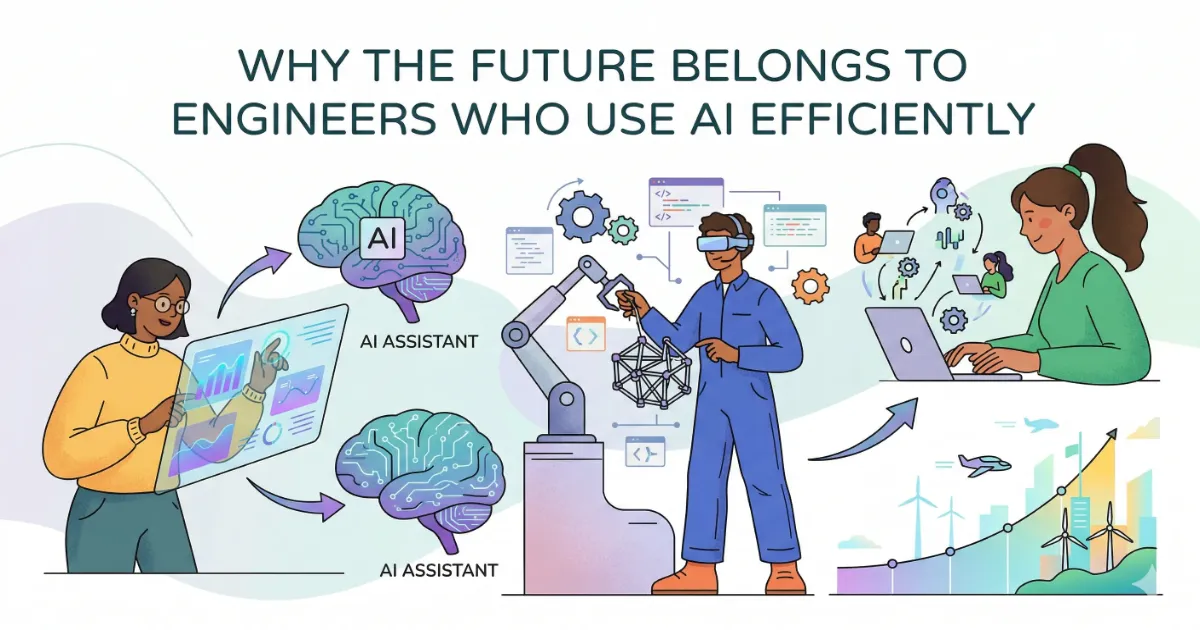
Why the Future Belongs to Engineers Who Use AI Efficiently
From writing code to designing systems — efficiency with AI is the new superpower
One sentence is dominating every tech conversation right now:
"AI will replace engineers."
That is the wrong framing.
The better framing is this:
AI will not replace engineers.
Engineers who work with AI efficiently will outpace those who do not.
The competitive edge is no longer just "Can you code?" It is "Can you design a workflow where AI meaningfully multiplies your output?"
The New Engineering Edge
Great engineers have always stood out through three things:
- strong technical fundamentals
- fast debugging and decision-making
- deep system-level thinking
Now there is a fourth differentiator:
AI collaboration efficiency
That means you can:
- move from idea to prototype faster
- reduce repetitive manual work
- improve first-draft quality
- ship with fewer back-and-forth cycles
Efficiency is the multiplier. Skill is still the foundation.
The Real Problem
Most developers do use AI, but many still use it in low-leverage ways:
- as a search replacement
- as a one-shot code generator
- as a quick patch tool
This usually creates:
- inconsistent output quality
- extra rewrite overhead
- no reusable process
Result: activity goes up, but true productivity barely moves.
The Shift: From Prompting to Engineering
Using AI is easy.
Using AI well requires:
- structure
- repeatability
- feedback loops
The goal is not:
"Use AI more."
The goal is:
"Build systems that let AI produce reliable outcomes."
5 Steps to Become an AI-Efficient Engineer
Step 1 - Think in Systems, Not Single Prompts
Random prompts produce random quality.
Instead, define:
- context
- constraints
- expected output format
- acceptance criteria
Treat every prompt like an interface contract.
Step 2 - Build Reusable Prompt Templates
Do not rewrite instructions from scratch every time.
Create templates for repeat work:
- UI components
- API routes
- database operations
- test generation
- refactoring
Example Template
Task: Create a React component.

Context:
- Feature: [describe feature]
- Audience: [who uses it]

Constraints:
- TypeScript
- Tailwind CSS
- Accessible semantics
- Reusable props

Output:
- Production-ready code
- Brief explanation of tradeoffs
- Suggested test cases
Step 3 - Create Verification Checklists
Speed without validation creates bugs faster.
Use a lightweight checklist before accepting AI output:
- correctness
- security implications
- performance impact
- edge cases
- readability and maintainability
This is where engineers stay irreplaceable: judgment.
Step 4 - Build a Personal AI Playbook
Store your best templates and workflows in one place.
Example structure:
/prompts
	/frontend
	/backend
	/debugging
	/testing
	/system-design
Over time, this becomes a compounding asset, not just a folder.
Step 5 - Iterate Like an Engineer
Do not expect perfect output in one pass.
Use a cycle:
- Generate
- Review
- Refine
- Validate
- Productionize
Example refinement prompt:
Refactor this code for:
- readability
- modularity
- stronger typing
- testability
Treat AI like a capable junior teammate: fast, helpful, and in need of clear direction.
What Efficient Engineers Do Differently
High-leverage engineers:
- reuse systems instead of rewriting instructions
- automate recurring decisions
- validate before trusting
- optimize for cycle time, not just code volume
- turn useful patterns into internal tools
They do not just use AI. They engineer around it.
Why This Compounds
Imagine saving 5 minutes on each task.
At 20 tasks per day, that is 100 minutes daily. Across months, that becomes days or weeks of recovered engineering capacity.
And unlike one-time speed hacks, process improvements keep paying you back.
Final Thought
The future is not human vs AI.
It is engineers who build reliable AI workflows vs engineers who stay ad hoc.
AI is the tool.
Efficiency is the skill.
TL;DR
AI-efficient engineers win because they:
- design structured prompt systems
- reuse templates and checklists
- validate output rigorously
- build personal workflow libraries
- iterate until outcomes are production-ready
Do not just ask AI for answers.
Build an engineering process where AI becomes leverage.


