Modernizing Data Pipelines with AI Agents: Real-World Engineering Use Cases
How intelligent agents are transforming schema management, data quality, and pipeline orchestration
Sun Mar 08 2026
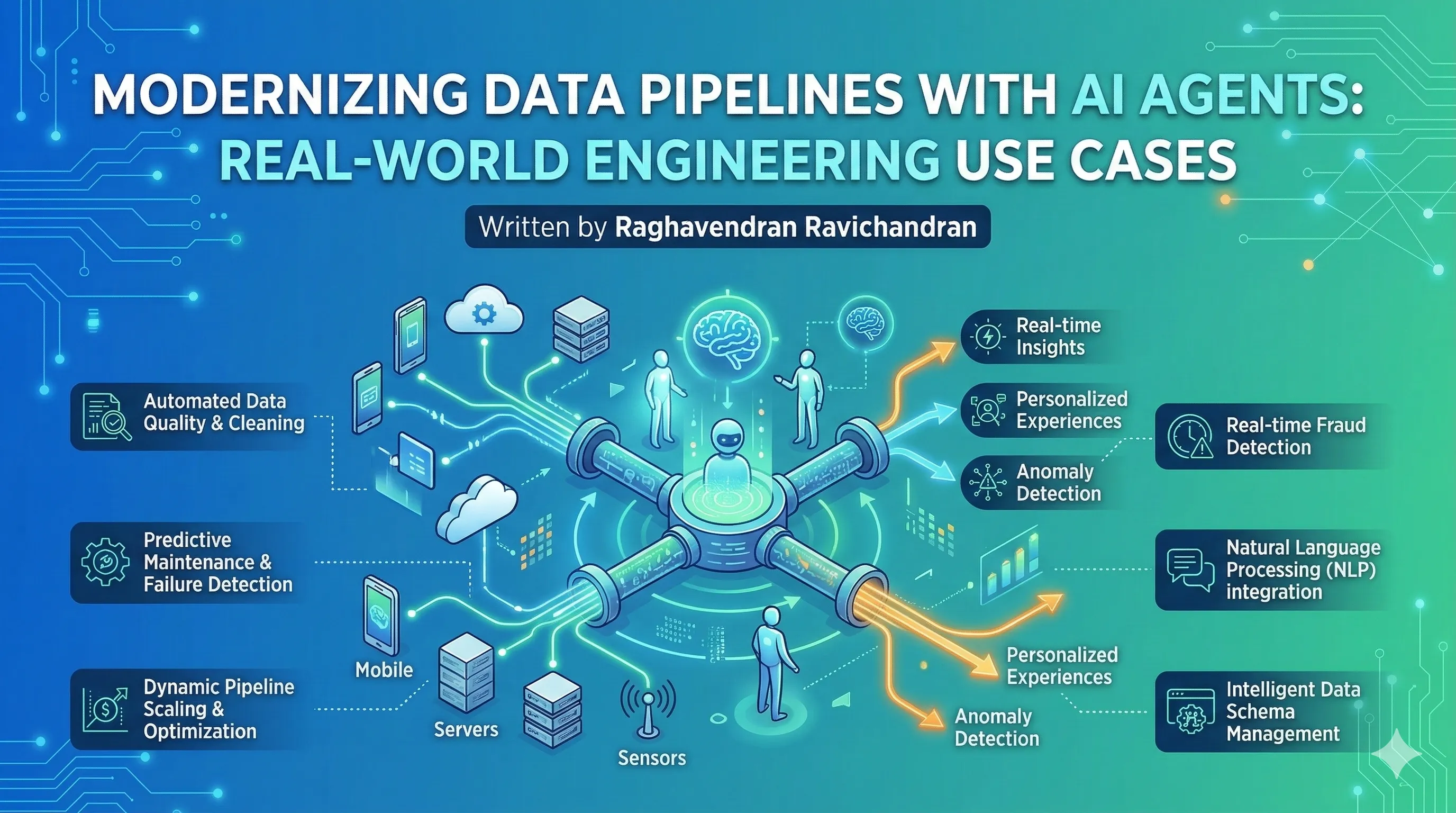
Pipeline Modernization With Anthropic Agents: Real-World Use Cases
Most data pipelines weren't built for what the world now expects from data. They were built to move rows from one place to another — reliably, on schedule, without drama. That was enough in 2018. It's not enough today.
Modern AI systems demand pipelines that don't just transport data — they curate it, validate it, enrich it, and route it intelligently in near real time. And engineering teams are stuck: legacy orchestration tools weren't designed for this. Rebuilding from scratch is expensive. Incremental patches break under scale.
This is where Anthropic agents — built on Claude — are carving out a genuinely new category in the data engineering stack. Not as a replacement for your warehouse or orchestrator, but as an intelligent layer that sits above your infrastructure and makes decisions that humans used to make manually.
This article is a practitioner-level breakdown of the actual use cases — concrete scenarios where Anthropic agent-based architectures are modernizing data pipelines in production today.
If you're a data engineer, platform engineer, or ML ops practitioner wondering where AI agents fit in the pipeline stack — this one's for you.
1. Intelligent Schema Change Detection and Auto-Remediation
Schema drift is one of the most persistent pain points in any data platform. A source system quietly adds a column, renames a field, or changes a type — and your downstream models silently break. You find out when a dashboard goes red at 9am.
The Old Way
Static schema contracts with hard failures, or loose ingestion that swallows corrupt data without warning. Both are bad. One halts pipelines. The other poisons your warehouse with garbage.
What Anthropic Agents Bring
An agent built on Claude can be deployed as a schema guardian — continuously comparing incoming payloads against defined contracts. When drift is detected, instead of just throwing an error, the agent:
- Analyzes the nature of the change (additive vs. breaking vs. type-narrowing)
- Checks lineage to understand which downstream models and dashboards are affected
- Classifies the change as auto-remediable or requiring human review
- Drafts a migration proposal — including updated dbt model code and a Slack notification to the owning team
This isn't just parsing diffs. Claude's natural language reasoning lets it understand context — e.g., "user_id changed from INT to VARCHAR" is a breaking change in 11 downstream joins, not just a schema footnote.
Real-world impact: A fintech team reduced schema-related pipeline failures by 74% after deploying a Claude-backed schema agent in front of their Kafka ingestion layer.
2. Automated Data Quality Triage and Root-Cause Reasoning
Data quality tools like Great Expectations or Soda are great for flagging anomalies. The problem is: they flag everything. Engineers end up drowning in alerts without the bandwidth to investigate all of them.
The Gap
Traditional DQ tools answer "is this bad?" — they can't answer "why is this bad?" or "does this actually matter?"
Where Agents Shine
Anthropic agents can be given access to your observability layer — query history, DAG logs, ingestion timestamps, upstream SLA metadata — and do the root-cause triage that a senior data engineer would do manually:
- Cross-reference the anomaly timestamp with upstream pipeline run logs
- Check if the anomaly correlates with a recent deployment or config change
- Pull sample rows from the affected partition and describe what's wrong in plain English
- Recommend whether to quarantine, backfill, or escalate based on business impact
The agent doesn't replace your alerting system — it sits downstream of it as an intelligent triage layer. Instead of 40 Slack alerts, your on-call engineer gets three clearly-ranked incidents with root-cause summaries attached.
This is the difference between an alert and an insight. One tells you something is broken. The other tells you why, how bad, and what to do next.
3. Natural Language to Pipeline — Accelerating DAG Development
One of the most underrated bottlenecks in data teams isn't infrastructure — it's the time it takes analysts to turn a business question into a functioning pipeline. The translation from "we need weekly churn by cohort" to a working Airflow DAG, dbt model, and Snowflake table can take days.
Agent-Assisted Pipeline Generation
With a Claude-powered agent embedded into your development workflow, analysts and engineers can describe what they need in plain language — and the agent scaffolds the pipeline:
- Interprets the business requirement and maps it to available source tables
- Generates a dbt model with appropriate grain, joins, and business logic
- Writes an Airflow DAG with correct scheduling, retries, and dependency wiring
- Adds data quality checks at each stage
- Writes inline documentation and lineage tags
This isn't "AI writes your code and you blindly ship it." It's more like pairing with a very fast junior engineer who knows your stack's conventions and writes a solid first draft in 3 minutes instead of 3 hours.
What Makes This Work With Claude Specifically
Claude's extended context window allows the agent to hold your entire dbt project structure, source schema catalog, and naming conventions in context simultaneously. It can write code that follows your team's patterns — not generic boilerplate.
Teams using agent-assisted DAG scaffolding report a 60-70% reduction in time-to-first-PR for new data products.
4. Intelligent Data Contract Enforcement Across Domains
Data mesh architectures solve the ownership problem — but they introduce a coordination problem. When dozens of domain teams own their own data products, enforcing consistent contracts, SLAs, and quality standards across all of them becomes a full-time job.
The Challenge
Central data platform teams end up acting as traffic cops — reviewing contract PRs, chasing domain teams for documentation, debugging cross-domain join failures. This doesn't scale.
Agents as Contract Orchestrators
An Anthropic agent can act as an always-on contract compliance layer:
- Reads incoming data product registrations and validates them against organizational standards
- Automatically comments on PRs with specific compliance issues and suggested fixes
- Monitors contract adherence in production and flags SLA breaches with context
- Generates audit reports for governance teams in human-readable format
Because the agent understands context — not just patterns — it can make nuanced judgments. A domain team shipping a "breaking change" to an internal-only table gets a different response than one modifying a contract used by 12 downstream consumers.
This is particularly valuable for regulated industries. An agent that can generate human-readable audit trails of data contract compliance is something compliance teams actually want to read.
5. Metadata Generation and Data Catalog Enrichment — at Scale
Every data team knows the state of their data catalog: outdated, incomplete, or completely empty. Cataloging is important. It's also tedious, which is why it never gets done.
The Manual Tax
Writing useful documentation for 500 dbt models, 200 source tables, and 80 dashboards is not a sprint task. It's a months-long effort that gets deprioritized every time there's a fire to fight.
Agent-Driven Catalog Generation
An Anthropic agent connected to your metadata layer — dbt docs, BigQuery INFORMATION_SCHEMA, data lineage graphs — can:
- Generate natural language descriptions for each model and column based on its SQL logic, lineage, and naming
- Infer business domain ownership from column patterns and usage frequency
- Identify and flag undocumented high-traffic tables as a priority backlog
- Continuously re-enrich metadata as models evolve, keeping the catalog current automatically
The output isn't generic filler text. Claude can reason about what the model actually does — "this model computes rolling 7-day revenue per customer segment, joining orders with CRM data" — because it's reading the SQL, not hallucinating descriptions.
A catalog that's 90% auto-generated and 10% human-reviewed is infinitely more useful than one that's 100% aspirational.
6. Backfill Planning and Incident Recovery Orchestration
When a critical pipeline fails — especially one with multi-day lookback windows — recovery is a stressful, manual process. Engineers have to work out which partitions are affected, in what order to re-run them, and whether downstream consumers need to be paused.
What Usually Happens
The on-call engineer runs through this mentally, makes a plan in their head, and re-runs DAGs manually — hoping they got the dependency order right. It's high-stakes and error-prone.
Agent-Orchestrated Recovery
An Anthropic agent with access to your lineage graph, Airflow run history, and partition logs can:
- Automatically identify the blast radius of a given pipeline failure
- Compute the optimal backfill order accounting for upstream dependencies
- Estimate the compute cost and time window for the recovery
- Generate a runbook — step-by-step, in plain English — for the on-call engineer to approve and execute
- After recovery, produce an incident summary with timeline, root cause, and recommended safeguards
The agent doesn't necessarily execute the recovery autonomously — many teams want a human in the loop for production mutations. But it compresses 2 hours of investigation into a 5-minute review cycle.
7. Multi-Agent Pipelines: When One Agent Isn't Enough
The most sophisticated applications aren't single-agent workflows — they're coordinated multi-agent systems where specialized agents handle different layers of the pipeline and hand off to each other.
A Practical Architecture
Consider a real-time fraud detection pipeline modernization:
- Ingestion Agent: monitors Kafka streams, detects schema drift, validates payloads
- Enrichment Agent: calls external data APIs, appends identity graph data, resolves entity ambiguity
- Quality Agent: runs statistical checks on enriched records, quarantines outliers
- Routing Agent: decides whether a record goes to the hot path (real-time scoring) or cold path (batch analysis)
- Observability Agent: monitors end-to-end latency, generates alerts with context when SLAs breach
Each agent is a Claude instance with a specific system prompt, tool set, and scope. They communicate through a shared message queue — not shared memory. The Anthropic API's tool use capabilities make this orchestration clean and auditable.
Multi-agent pipelines are still early-stage in most organizations, but teams building them report that the decomposition of concerns — each agent doing one thing well — makes the system dramatically easier to debug and evolve.
Architecture Considerations: What You Need to Make This Work
Running Anthropic agents in a data pipeline isn't just an API call. There are real infrastructure and design decisions involved.
Tool Access Is Everything
Agents are only as useful as the tools they can call. At minimum, your agent setup needs read access to your metadata layer, lineage graph, and observability platform. Write access (for catalog enrichment, PR comments, Slack notifications) expands the use cases significantly — but comes with governance requirements.
Stateless vs. Stateful Agents
Most pipeline agents should be stateless — they receive context in the prompt, reason over it, and return a result. For multi-step workflows (like incident recovery), you'll need state management, either via a message queue or a coordination layer like LangGraph or a custom orchestrator.
Cost and Latency Budgets
Claude Sonnet is fast and cost-effective for most pipeline orchestration tasks. For latency-critical paths (real-time routing, streaming validation), pre-compute as much context as possible and keep prompts lean. For high-complexity reasoning tasks (root cause analysis, migration planning), the token spend is almost always worth it versus the engineer time it replaces.
Human-in-the-Loop Design
The most successful deployments we've seen keep humans in the loop for any agent action that mutates production state. Agents propose, humans approve. This builds trust incrementally — and means your team actually understands what the agents are doing.
Apptastic Insight
Data pipelines are no longer just infrastructure — they're decision-making systems. The question isn't whether AI agents belong in your pipeline stack. It's which decisions you want them making, and which ones you want humans to own. The teams moving fastest on this aren't the ones with the most sophisticated AI — they're the ones who've drawn that line clearly.
Further Reading
To go deeper on the tools and frameworks referenced in this article:


